Now and then some information on community music making pops up in archives. This quote is from the collection of oral history in the Subiaco Museum, WA, including information on an interesting home-made instrument. The speaker is Mrs Eulie Broome, interviewed by Donna Moore on 11 November 1983:
We had some people going to our church called Foot. Mr Foot was a shopwalker in Bon Marche, which was burnt down later, that was a terrific evening, you could see the fire, even from here. Anyway, his wife was very musical, and she had a band. For a long time, the eldest daughter Esme was our church organist, and she also played the violin. Mr Foot played the violin. Arthur played the violin. Maud didn't play anything; I suppose she got the supper or something. And Norman was the one, he was my age group. He played cello. But he also played a violin, and he also made up a few instruments. One he made, played, was a single [string?] violin on a cigar box. It made quite a different tone from a violin, and he also made one using a kerosene tin for the sound box. He called that his ‘kerosene tingaling’, and he also sang and you know, they were a very great asset to a party, or to a church ...(indistinct – possibly ‘party’ or similar function)
Norman’s ‘tingaling’ sounds like the ‘rumpumscrumpum’, a Shropshire, England, instrument consisting of a single string attached to both ends of a board and strung across a tin can as a sounding box and bridge. A ‘kerosene tin dulcimer’ of similar construction has been documented in NSW and no doubt many others knocked up comparable devices to provide some basic melody and rhythm when required.
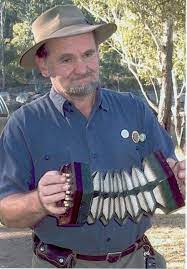
Unfortunately, the Subiaco Museum doesn’t have a ‘tingaling’, but it does have some instruments used for music in the area around the early-mid 20th century, including a zither, autoharp and an accordion, pictured and described below, complete with a family snap of the accordion in action and a recent commemorative mural by noted artist and author, Shaun Tan, a local resident.
Subiaco seems to have been a bit of a music hot spot. The suburb - and nearby Jolimont - became the home of JMG instruments after World War 2. Les O’Connell and Jack Maskiell were POWs in Changi, when they returned home they set up a factory making ukeleles for an earlier uke-fad era, as well as other stringed instruments. Les had built homemade instruments for the famous concerts that were such important morale boosters in Changi and Jack made instruments in Adelaide before the war. When he and Jack came home, they just kept going.

1985.1241 MUSICAL INSTRUMENT: 'THE AUSTRAL ACADEMY OF MUSIC' MANDOLIN-GUITAR
Wooden Zither painted black. Strings fixed to flat horizontal base. One side straight, other side curved, curves back to narrower top along the edge of which project at right angles sixty-two square-faced string adjustment keys. Strings are a mixture of narrow gauge wire and spring type. They are strung parallel to each other across the front surface of the zither over a circular hole cut into this surface. The zither is decorated with multi-coloured floral design transfers around the front surface border, around the circular hole and bordering the note scale director which runs across the zither at right angles to the zither strings.
Inside the zither and visible through the hole is the manufacturer's label. ' The Austral Academy/ MANDOLIN GUITAR/of/Music'.Label on reverse: 'Made in Germany'. Also known as a Zither and Autoharp

1986.154 MUSICAL INSTRUMENT: 'MULLER'S' MONOPOL AUTO-HARP AND PLECTRUM
a) Flat lacquered wood box, with twenty-five steel strings. Across the centre of these strings is a wooden box containing felt dampers operated by six brass stops. When the stops are pressed, the tone of the strings is altered by pressure of dampers. Strings are attached to metal pegs, strung across the sounding board and looped over small metal pins at the other end. Surface of instrument below the strings is elaborately inlaid in different coloured woods in a picture of flowers, leaves and a butterfly. The box supporting the stops is inlaid with brass design of a lyre encircled by a wreath. Also inlaid on this box is "Muller's Auto-Harp" "Monopol". Six brass buttons are attached. The lower part of the base has a celluloid plaque beneath the strings giving string number, string note and a staff with the note on. At one end of the upper box is a paper label. On opposite edge of base is a metal plate, oval. The base has four brass studs to raise it from the table.
b) Plectrum for above. Curved brass plectrum for plucking strings.

1985.714a-b MUSICAL INSTRUMENT: 'HOHNER'S ACCORDEON' (ACCORDION) AND BOX
a) M Hohner accordion with 10 keys which has mother of pearl at the end (buttons) on extension piece. At opposite front part next to the 10 fold bellows, one finds 4 bass keys (also buttons in mother of pearl). Underneath this at the right (width of accordion) a stop button (mother of pearl). At 8 corners of bellow folds chrome plates marked 'M HOHNER ACCORDEON* BEST MADE - TRADE IN GERMANY'. Facing keyboard in gauze (green) covered by intricate wood carving design, small chrome plate and screw attach it to the frame. Two hooks at upper part and two metal hooks at lower part of each side of bellows to protect them.
b) Wooden Box with leather strap and metal knocker handle. (Not shown) * Please note spelling. English version is 'accordion' – OWNED BY HANCOCK FAMILY!

PHOTOGRAPH: HANCOCK FAMILY AND FRIENDS AND ACCORDIAN - Front:
The photograph was taken out of doors and features Hancock family members and friends, with several children. Three men and three women stand in the back row, and several women and children kneel on the ground in the front. One woman has her right arm against the mudguard of the vehicle on the right shading her face from the sun. All are dressed in casual clothing.
Tom Hancock stands holding the accordion, which was donated to the Subiaco Historical Society. The man standing next to him holds a small dog. The group is arranged between a motor vehicle at the right of the image and a lorry at the left. The word 'Carrier' can be seen running along the side of the lorry. There are several large trees in the background.
MURAL: 'THE 100 YEAR PICNIC', SHAUN TAN
Image: Four large panels making up one large work. Mixed media on canvas panels.
The image is a colourful interpretation of a photograph of a Hancock Family picnic taken around 1925. In both the original photograph and the artwork, the central figure Tom Hancock plays the accordian. The museum holds this very Hancock family accordian in its collection.
Frame: Unframed.

Transcript and photographs courtesy Kylie Seal-Pollard (she/her) | Museum Officer
City of Subiaco | PO Box 270 | Subiaco WA 6904
92379222 | kylies@subiaco.wa.gov.au | www.subiaco.wa.gov.au